Kyrgyz National Costume
The Kyrgyz national costume, formed over centuries, reflects the nomadic lifestyle of the people, harsh climatic conditions, and rich cultural traditions. At its core lies practicality, comfort, and functionality, combined with elegance and beauty.
Women's Costume
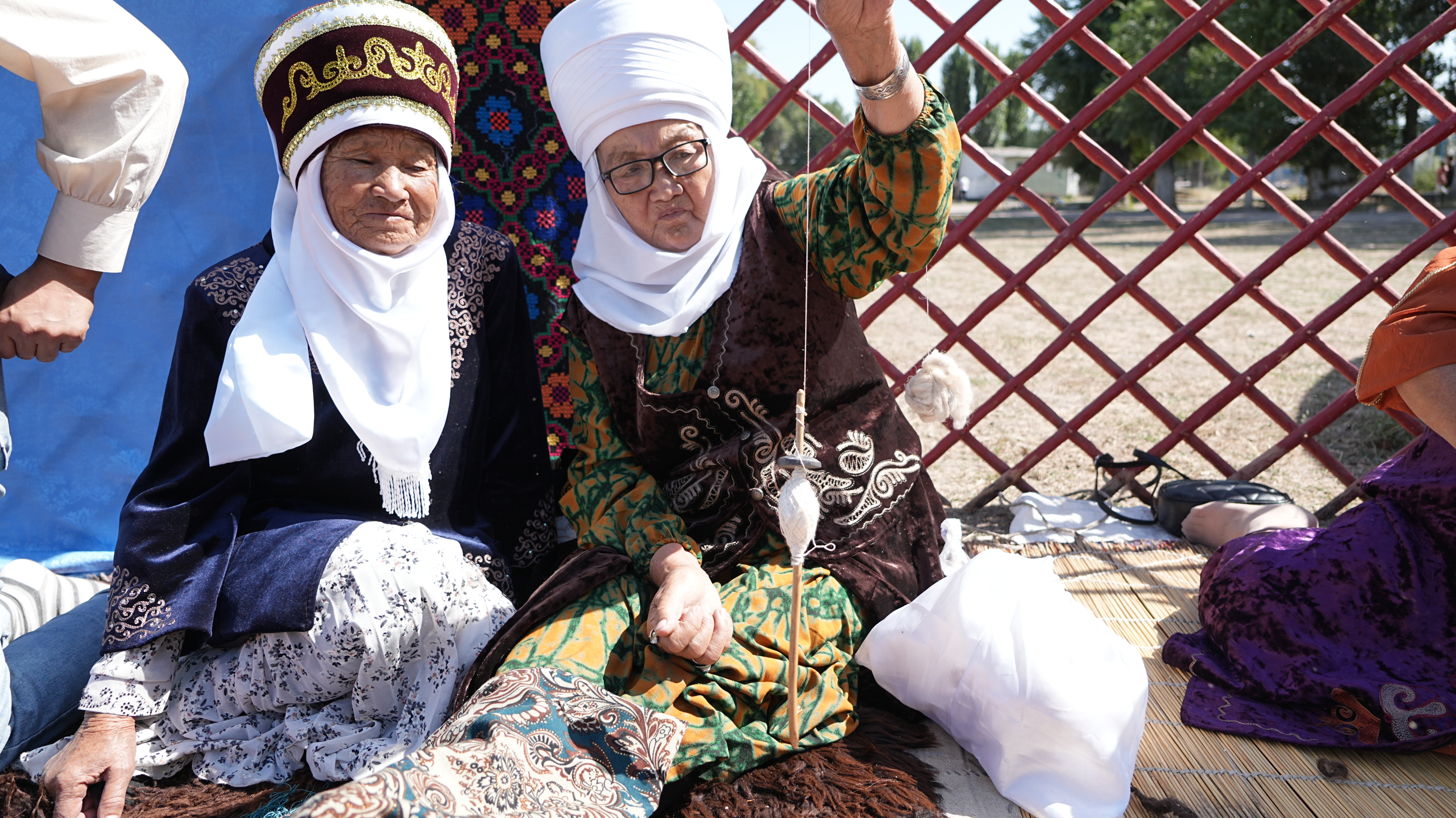
The women's costume was characterized by layering and diversity. The base consisted of a tunic-dress "koynok" sewn from cotton, silk, or satin fabrics, with differences in color and decorations depending on age and social status. Over the dress, a "beldemchi" – an apron-skirt, symbolizing motherhood, richly decorated with embroidery – was worn. In cold weather, an "ichik" – a warm sheepskin coat, trimmed with silk or velvet – was worn. Special attention was paid to headdresses: married women wore complex turbans "elechek," the size and decorations of which indicated the family's wealth. Hairstyles also played an important role, with braided hair hidden in embroidered hair holders.
Men's Costume
The men's costume was more laconic but no less functional. It consisted of a shirt and spacious trousers, sewn from cotton or wool, and in winter – from sheepskin. Over this, warm coats were worn: a "kementay" made of felt or a "chapan" – a quilted fabric robe, which could be both a winter and summer option. A "kalpak" – a white felt hat, which is a symbol of Kyrgyz culture – served as a headdress. Footwear, from simple leather sandals to skillfully made boots, indicated the social status of the owner.
Russian National Costume
The Russian national costume, formed over the centuries, reflects the rich history and traditions of the Russian people. Its origins go back to Ancient Rus, and its final formation took place in the Moscow Tsardom. The costume was distinguished by a variety depending on the region, social status, and age.
Men's Costume
The men's costume was distinguished by simplicity and practicality. The main elements were a kosovorotka shirt, ports (trousers), and a caftan. Shirts were sewn from linen or cotton, often decorated with embroidery. Caftans, varying in length and material, served as outerwear. Onuchi, leg wraps, were worn with bast shoes or boots. In winter, an indispensable footwear was valenki – warm felt boots.
Women's Costume
The women's costume was more complex and elegant. The basis consisted of a shirt and a sarafan. Sarafan, long sleeveless dresses, were sewn from a variety of fabrics and decorated with embroidery, ribbons, and beads. Outerwear included summer coats, opashni, dushegreiki, and fur coats. Headdresses, such as kokoshnik, povoinik, and scarves, were important and varied depending on status and region. Unmarried girls wore wreaths with ribbons. Shoes were mostly leather, and for the poor layers of the population, bast shoes. In winter, like men, women wore valenki.
The red color, a symbol of fire and sun, occupied a special place in the Russian costume. Clothing reflected age characteristics: young girls wore bright outfits, and children and elderly people - more modest ones. Ornaments, including images of people, animals, and plants, had symbolic meaning.
Dungan National Costume
Dungan national clothing, combining elements of Chinese, Russian, and Central Asian cultures, reflects the unique position of this people. Individual Dungan communities preserved their types of clothing details, and in general, Dungan clothing underwent changes over time under the influence of surrounding cultures.
Men's Costume
The basis of the men's costume consisted of an open jacket-semi-caftan (guazy) and a long robe, mostly dark colors. Under the jacket, they wore wide shirts (sanzy), which over time began to be worn over the head. Narrow pants (kuzy) were worn with wraps of the same fabric. Footwear included cloth socks and shoes with a dark top and cardboard sole, as well as soft boots. Headdresses were fur hats, felt hats, and straw hats with skullcaps. Wealthy Dungans wore fur coats and jackets of high-quality materials.
Women's Costume
Women's clothing was similar to men's but differed in brighter colors and long wrap-around jackets. Parade pants were decorated with wide stripes and ribbons. An essential element of the costume was a sleeveless jacket (jajyazy). Women wore cloth socks and shoes, often richly embroidered. Girls braided their hair, and women made lush hairstyles decorated with flowers and silver combs. Elderly women covered their heads with a scarf. Women wore earrings, bracelets, and chest ornaments. A special highlight was the bride's wedding costume, which included a silk robe and an elegant collar pyijyan, richly embroidered with silks. The bride had to embroider her wedding shoes herself, by which her craftsmanship was judged.
Children's clothing often repeated adult clothing but was sewn from red fabric. The clothing of elderly Dungan women of the Shensi group was closer to Manchurian. Various Dungan communities preserved their unique clothing details. Dungan footwear was comfortable. Chinese cultural influence is evident in Dungan clothing.
Uyghur National Costume
The Uyghur national costume is a vivid reflection of the culture and traditions of the Uyghur people, who primarily live in the Xinjiang Uyghur Autonomous Region of China. It is distinguished by a variety of styles, colors, and materials, reflecting both historical traditions and modern trends.
Men's Costume
The basis of the men's costume is the chapan (doppa) – a traditional robe that can be both everyday and festive. It is often decorated with embroidery and ornaments. Under the chapan, they wear a shirt (koynek), as well as wide trousers (dambal), comfortable for movement. An integral part of the Uyghur costume is the skullcap (doppa), which can be of various patterns and shapes. A belt (belbag) is often decorated with embroidery.
Women's Costume
The women's costume is distinguished by elegance and colorfulness. The main element is a dress (koynek) – a long dress that can be both simple and elegant, decorated with embroidery and appliques. Under the dress, they wear shalwars (dambal). A vest (kemisal) is often worn over the dress. The headdress (lechkik) consists of various scarves and shawls with which women cover their heads. Uyghur women love jewelry, such as earrings, necklaces, bracelets, and rings.
The Uyghur costume is characterized by the use of bright colors and patterns, reflecting the Uyghurs' love for beauty and art. Embroidery is an important element of decoration, and the variety of headdresses has its own meaning and symbolism. Natural materials such as cotton, silk, and wool are used in the costumes. Modern trends also bring new styles to the national costume.
Uzbek National Costume
Uzbek national costumes, distinguished by their brightness, beauty, and comfort, are an integral part of the rich cultural heritage of the Uzbek people. In modern urban spaces, national clothing is most often used at traditional festive events, while in rural areas, it retains its role in everyday and festive wardrobes.
Men's Costume
The basis of the men's national costume is the chapan – a quilted robe, tied with a waist scarf kiyikcha. Under the chapan, a kuylak – a straight-cut undershirt, and ishton – wide trousers tapering at the bottom – are worn. Footwear consists of thin leather boots. The headdress is a tubeteika. Parade belts are decorated with velvet, embroidery, silver plaques, and buckles, while everyday belts are tied with a long scarf-like sash.
Women's Costume
The traditional women's costume consists of a tunic-like dress made of khan-atlas and sharovars. Festive outfits are distinguished by the use of satin fabrics and gold embroidery. The women's headdress includes a tubeteika, a scarf, and a turban. Indispensable additions are jewelry made of gold or silver.
Embroidery patterns carry magical or practical meaning, reflecting social status and other symbolic meanings. Geometric patterns on the braid serve as a charm. Dark blue and black colors are not used in clothing. Sogdian patterns retain the influence of Zoroastrianism, and colors reflect social status. Blue and purple shades in a woman's dress indicate the high status of her husband, and greenish motifs indicate belonging to peasants or artisans.
Footwear and Headwear
Footwear consists of makhsi (ichigi) and boots made of rough leather or rubber, distinguished by comfort and warmth. Tubeteika, the national headdress, has a quadrangular cone-shaped form and is worn by men, women, and children, with the exception of elderly women. The traditional tubeteika is black with white embroidery in the form of "peppers" and arches. There are six main schools of tubeteika sewing, differing in patterns and height: Fergana, Tashkent, Kashkadarya-Surkhandarya, Samarkand, Bukhara, and Khorezm-Karakalpak. For festive occasions, elegant tubeteikas with bright embroidery and gold embroidery are made.
Where to Buy National Costumes in Chuy Region
Bazaars (Markets)
Osh Bazaar is one of the largest and most famous markets in Kyrgyzstan. It's a place where you'll find vendors selling traditional costumes from various national groups, including Kyrgyz, Russian, Dungan, Uyghur, and Uzbek. You can also find traditional fabrics, hats, jewellery, and accessories in the bazaar.
Dordoi Bazaar is another major shopping center, Dordoi has a section dedicated to textiles and traditional clothing.
Tokmok Bazaar (Bulak) – A smaller but still diverse market where locals buy and sell national attire. This is a good place to find regional craftsmanship.
Craft Shops and Studios
Many local artisans and craftspeople in Chuy Region specialize in creating traditional costumes. You can visit workshops or studios that produce handmade costumes, often offering high-quality, authentic pieces. In Bishkek and its surroundings, there are many workshops specializing in sewing national costumes.
Кийиз Дүйнө - Felt World
“Felt World - Nomadic Spirit” - a project of the Public Foundation “Min Kiyal”, aimed at reviving and preserving the traditional knowledge of the Kyrgyz people on felt craft and the cultural space around it.
Here you can watch master classes on wrapping the headgear “elechek”. Take part in classes on making your own skirts “beldemchi”' and men's headress “ak kalpak”.
https://www.instagram.com/kiyizduino?utm_source=ig_web_button_share_sheet&igsh=ZDNlZDc0MzIxNw==
https://www.instagram.com/voilok_kiyiz_felt?utm_source=ig_web_button_share_sheet&igsh=ZDNlZDc0MzIxNw==
A selection of Kyrgyz ethnic brands that create clothes that blend traditional motifs with modern design, preserving the cultural heritage in each piece. These stores may be pricier but ensure authenticity.
Baira
https://www.instagram.com/baira.kg?utm_source=ig_web_button_share_sheet&igsh=ZDNlZDc0MzIxNw==
ags_etno
https://www.instagram.com/ags_etno?utm_source=ig_web_button_share_sheet&igsh=ZDNlZDc0MzIxNw==
Peri_etno.kg
https://www.instagram.com/peri_etno.kg?utm_source=ig_web_button_share_sheet&igsh=ZDNlZDc0MzIxNw==
Qoorchaq
https://www.instagram.com/qoorchaq?utm_source=ig_web_button_share_sheet&igsh=ZDNlZDc0MzIxNw==
Olpok
https://www.instagram.com/olpok_?utm_source=ig_web_button_share_sheet&igsh=ZDNlZDc0MzIxNw==
Keshte
https://www.instagram.com/keshte.kg?utm_source=ig_web_button_share_sheet&igsh=ZDNlZDc0MzIxNw==
Cultural Centers and Museums
Some cultural centers and museums may have shops or displays where you can purchase traditional clothing and crafts. These centers also offer insight into the cultural significance of the attire.
Bir Qyzyq Jer is a concept store where you can find not only ethno-style clothing and jewellery, but also vintage items.
https://www.instagram.com/birqyzyq_jer?utm_source=ig_web_button_share_sheet&igsh=ZDNlZDc0MzIxNw==
Unique and ethnically inspired jewelry.
https://www.instagram.com/qyzyq_store?utm_source=ig_web_button_share_sheet&igsh=ZDNlZDc0MzIxNw==
For example, the State Historical Museum in Bishkek sometimes holds fairs where you can buy national clothing.